Tailored vs Standard Car Accident Claims Frameworks: Scope & Value Compared
Car accident claims frameworks are compared by scope, evidence strategy, case value, and fit for individual accident circumstances. A tailored framework adapts investigation and negotiation to the injury, liability, evidence, and recovery issues in the claim. Atlanta Auto Law evaluates those factors to build the appropriate approach.
Written by Ronnie Mabra
Request an EstimateOptions at a Glance
Tailored and standard frameworks both organize a personal injury claim. The right choice depends on how much case-specific analysis the accident requires.
- Tailored claims framework: Best for unusual evidence, serious injuries, disputed liability, or complex damages.
- Standard claims framework: Best for clear liability, documented injuries, and a straightforward insurance claim.
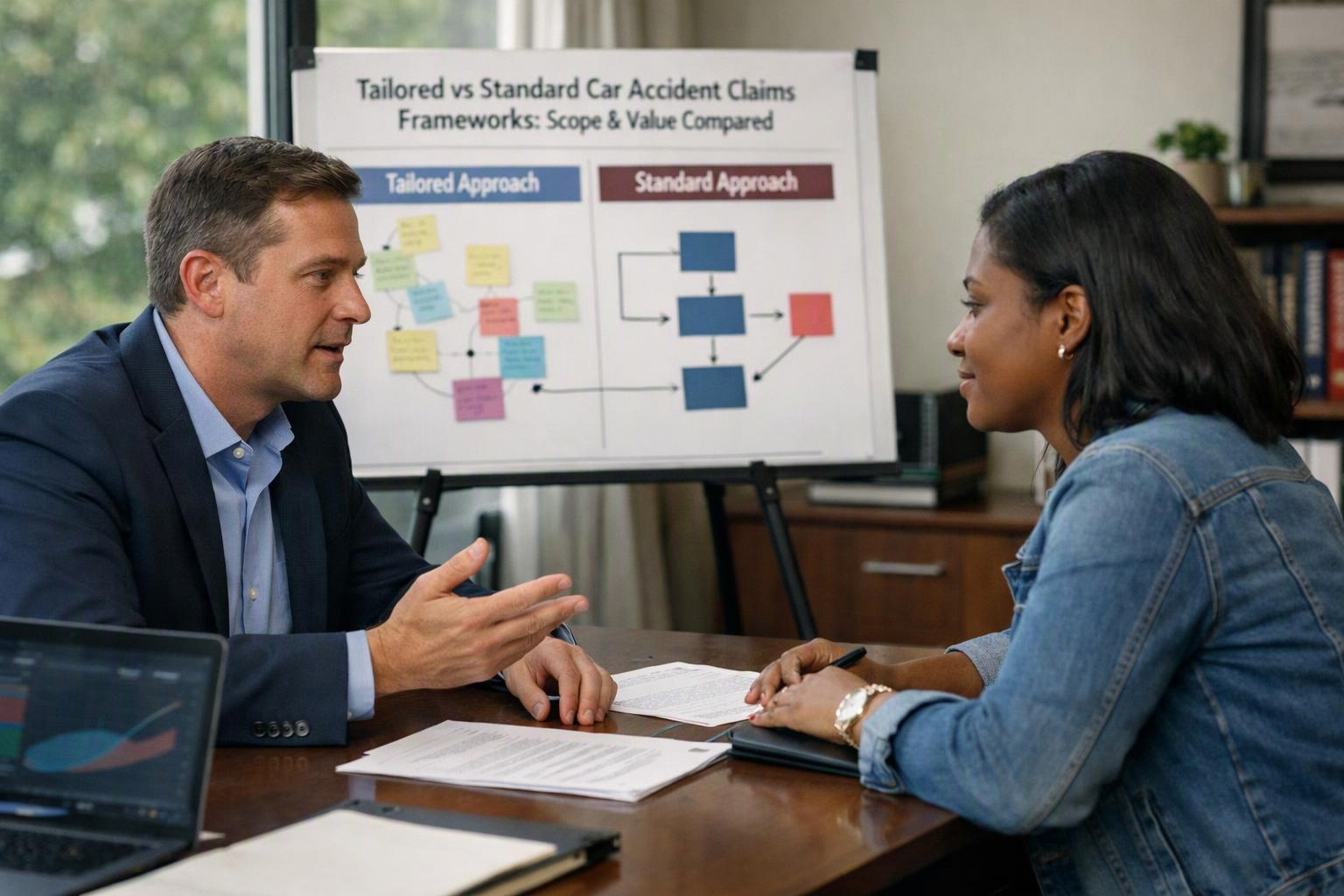
What Makes a Car Accident Claims Framework Tailored or Standard?
A tailored car accident claims framework adapts investigation and negotiation to the claimant's specific injuries, liability issues, evidence, and recovery needs. A standard claims framework follows a more consistent claim sequence when the facts are clearer.
A tailored claims framework may require focused accident investigation, deeper medical records review, or a detailed damages assessment. We use a standard claims framework when routine liability evidence, injury documentation, and insurance communication provide a reliable path.
The personal injury attorney handling the car accident claim should test the framework against the facts as the claim develops. Our team can adjust the case-specific strategy when new witness statements, vehicle damage evidence, or insurance coverage issues appear.
Tailored and Standard Claims Frameworks Compared
A tailored framework usually requires more case-specific analysis, while a standard framework offers a consistent structure for claims with clearer facts and fewer unusual issues. Both approaches should account for liability, damages, evidence, and claim maintenance.
| Factor | Tailored Framework | Standard Framework | Best Fit |
|---|---|---|---|
| Claim scope | Built around the accident's distinct issues | Follows a consistent claim sequence | The framework should match the facts |
| Evidence review | Focused review of unusual or disputed evidence | Routine review of available records | Clear or complicated evidence patterns |
| Liability analysis | May address disputed or multi-party fault | Usually addresses a clearer fault pattern | The available liability evidence |
| Case timeline | May require additional evaluation points | Often follows a more predictable sequence | The claim's evidence and recovery needs |
| Claim maintenance | Requires close updates as facts change | Uses regular documentation and communication | The level of ongoing case activity |
| Case value | May identify less obvious damages and risks | Addresses familiar damages categories | The proven losses and legal risks |
What Are the Advantages of a Tailored Claims Framework?
A tailored claims framework is stronger when injury effects, fault, evidence, or damages require analysis beyond a routine claim path. Our team connects the investigation to the medical and financial consequences shown by the records.
Best for: A tailored framework fits a complex car accident claim with serious injury, multiple liable parties, or contested insurance coverage.
Best Fit for a Tailored Framework
A complex car accident claim benefits from a tailored framework when the facts cannot be evaluated through a routine sequence. We examine how serious injury, multiple liable parties, or contested insurance coverage changes the investigation.
Our team may use liability-focused investigation, injury-focused damages analysis, or multi-party liability analysis as the evidence requires. We then connect those findings to the settlement demand and the claimant's recovery needs.
What Are the Advantages of a Standard Claims Framework?
A standard claims framework is useful when liability, injury documentation, and damages follow a relatively clear and familiar pattern. The structure helps keep medical records, insurance documentation, and claim communication organized.
Best for: A standard framework fits clear liability, documented injuries, a straightforward insurance claim, and routine settlement review.
Best Fit for a Standard Framework
A standard claims framework fits a claim with clear liability, documented injuries, and a straightforward insurance claim. We use a structured claim process to organize records, assess damages, and communicate with the insurance company.
Routine settlement review still requires attention to the complete claim. Our team checks whether the available evidence supports economic damages, non-economic damages, and the requested recovery.
How Does Framework Choice Affect Claim Scope and Value?
Framework choice affects claim scope and value by determining how thoroughly the claim addresses liability, medical consequences, financial losses, future effects, and negotiation risks. A framework does not create damages or guarantee a result.
Economic damages may include documented medical treatment, lost income, property damage, and supported future medical care. Non-economic damages may include pain and suffering and the effect of the injury on daily life.
Comparative fault can affect the analysis when more than one person may share responsibility. We review the evidence before presenting a settlement position so the claim value reflects proven losses and liability risks.
How We Choose the Right Framework for a Car Accident Claim
We choose the claim strategy after reviewing the accident investigation, available records, insurance coverage, and damages. Each step shows whether a structured claim process is sufficient or whether the case needs a more tailored approach.
When Should a Motorcycle Accident Claim Use a Tailored Framework?
A motorcycle accident claim should use a tailored framework when visibility, roadway conditions, rider evidence, bias about fault, or injury consequences require focused analysis. Motorcycle riders are vulnerable road users, so the evidence must address how the collision occurred and how the injuries developed.
We review roadway evidence, helmet evidence, vehicle visibility, witness statements, and the conduct of the at-fault driver. We also connect injury severity to medical treatment, recovery needs, and the damages claimed.
Our motorcycle accident claims team can apply a focused motorcycle accident claim strategy when ordinary assumptions about visibility or rider fault create a liability dispute. Learn more about our Motorcycle Accident Claims service.
How Can You Prepare for a Framework Review?
Preparing the core claim documentation helps us identify evidence gaps and select the right framework. Keep records organized and tell our team when new treatment, bills, or insurance correspondence arrives.
What Should You Ask Before Choosing a Claims Framework?
Ask whether the proposed framework addresses the facts that could change liability, damages, evidence, or settlement strategy. A useful legal consultation should explain what our team will investigate and how the findings will guide the claim.
Ask how we will identify case-specific investigation needs, close evidence gaps, evaluate liability disputes, and separate the damages categories. Ask how the settlement strategy will account for medical records, lost income, comparative fault, and future effects.
Atlanta Auto Law reviews the claim's evidence and recovery needs before recommending a standard or tailored approach. To request a consultation, contact us through our contact page.
Questions About Car Accident Claims Frameworks
Can a standard car accident claim become tailored later?
Yes, a standard car accident claim can become tailored when new evidence, disputed liability, changing medical needs, or insurance coverage issues require a different strategy. Atlanta Auto Law updates the framework when the facts show that a routine claim process no longer fits.
Does a tailored framework guarantee a higher settlement?
No, a tailored framework does not guarantee a higher settlement. It is designed to address the evidence, liability issues, injury effects, and damages that may affect claim value.
Which evidence helps determine whether a claim needs a tailored framework?
Evidence such as the police report, witness statements, accident photographs, vehicle damage, medical records, insurance correspondence, and wage-loss documentation helps show whether the claim has unusual issues.
How do motorcycle accident claims differ from standard car accident claims?
Motorcycle accident claims may require closer review of visibility, roadway evidence, helmet evidence, rider bias, and injury severity. Those issues can make a tailored framework appropriate.
What does a personal injury attorney review before recommending a claim framework?
A personal injury attorney reviews the accident investigation, liability evidence, medical records, insurance coverage, damages, comparative fault issues, and settlement risks before recommending a framework.
Written by Ronnie Mabra
Atlanta Auto Law reviews car accident and motorcycle accident claims with a strategy matched to the evidence and recovery needs.